
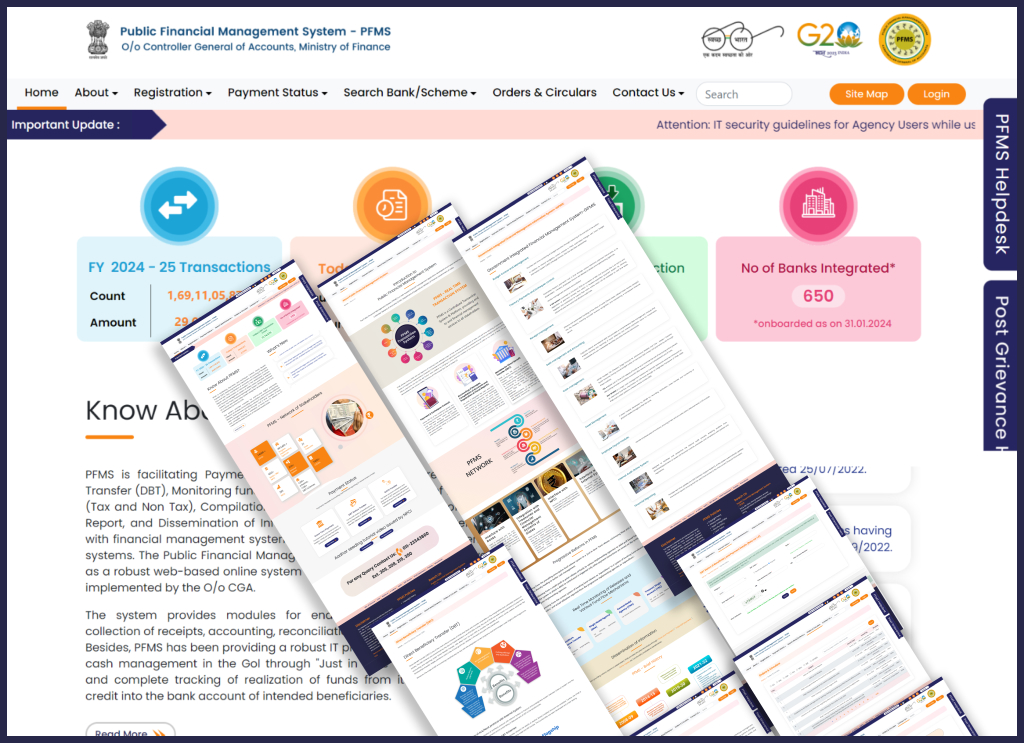
Business Context
Why this project mattered: PFMS is one of India's most important public financial platforms, serving millions of users across government departments and citizens. A modern, accessible, and user-centric experience was essential to improve information access, strengthen digital governance, and support long-term platform scalability.
The existing PFMS website had evolved over time, resulting in complex navigation, fragmented information architecture, and an outdated user experience that made information discovery and access to public financial services difficult.
Modernize the digital experience by improving usability, accessibility, information architecture, and content discoverability while ensuring compliance with GIGW standards.
- Improved information discoverability
- Simplified user navigation
- Enhanced accessibility compliance
- Scalable digital foundation
The Challenge
Complex Information Structure
Legacy User Experience
Accessibility Compliance
Diverse User Groups
Content Discoverability
Implementation Consistency
My Role & Responsibilities
- Defined and led the UX strategy for the digital modernization initiative.
- Restructured the information architecture to improve navigation and content discoverability.
- Facilitated stakeholder workshops to align business, policy, and user requirements.
- Guided the UX/UI team throughout the design lifecycle and review process.
- Coordinated with development, QA, and government stakeholders to ensure successful implementation.
- Governed implementation through design reviews, UAT, and accessibility validation.
- Established design consistency aligned with GIGW standards and enterprise UX best practices.
Stakeholders
Design Process (Our Approach)
Discover
Understand goals, stakeholders, and context
Research
User research, journey mapping, competitor study
Strategize
IA, user flows, prioritization, and experience strategy
Design
Wireframes, UI exploration, design system creation
Validate
Usability testing, feedback, and refinements
Govern & Evolve
Implementation support and continuous improvement
Enterprise Design Strategy
Restructured navigation to improve information discoverability.
Designed experiences aligned with GIGW accessibility standards.
Simplified complex content into intuitive user journeys.
Maintained implementation quality through continuous reviews.
Established reusable UI patterns for consistency and future scalability.
Key Design Decisions
Restructured content around user priorities.
Reduced complexity through logical grouping.
Applied GIGW-compliant interaction patterns.
Optimized layouts across multiple screen sizes.
Standardized interface patterns.
Design Constraints & Decisions
Legacy Content Structure
Modernized the experience while preserving essential content.
Government Standards
Balanced usability with mandatory compliance requirements.
Multiple Stakeholders
Aligned diverse business and technical expectations.
- Refined the existing information architecture instead of replacing it completely.
- Prioritized accessibility and usability while adhering to GIGW standards.
- Standardized reusable UI patterns to support scalable implementation.
Outcomes & Impact
Modern User Experience
Improved usability across the platform.
Better Discoverability
Simplified navigation and information access.
Accessibility Compliance
Aligned with GIGW guidelines.
Scalable Foundation
Established reusable patterns for future enhancements.